Discovering Whistler's Japan

I recently visited the new Whistler exhibition at Tate Britain. I was pleasantly surprised to discover how much attention it gives to his fascination with Japan.
The artistic threads that connect Europe and Japan are something I find myself returning to again and again. Whether it's David Bowie encountering Kabuki, Benjamin Britten discovering Nō, or Yellow Magic Orchestra drawing inspiration from German electronic music, I am fascinated by what happens when artists step beyond the boundaries of their own culture.
More specifically, I am drawn to how each tradition offers its own way of seeing, moving, listening and making. Sometimes, an unfamiliar culture can show an artist something they were already searching for, without quite knowing it.
Walking through the exhibition, I could not help but connect myself to Whistler. Here was an artist with a deep love for Japanese art, woodblock prints, fans, ceramics and screens, but his fascination did not seem merely decorative. It felt as though, through Japanese art, he was trying to discover something within himself and his own artistic style.
That is something I understand.
For almost ten years, I have been drawn deeper and deeper into Kabuki and Japanese theatre. At the beginning, my own performances were much more visually explicit. I wore wigs, Kabuki makeup and costume, and tried in some way to stage something that resembled Kabuki. Now, I find myself less interested in displaying Kabuki on the surface and more interested in searching for its essence. What is the movement? What is the feeling? What is the form beneath the image?

Japanese theatre is not an end in itself for me. It is a means of going deeper into my own self, as a human being and as an artist. People sometimes ask me, half-jokingly, why I am so fascinated by Kabuki. Do I have a Japanese lineage? Why this particular art form? Why this niche, specific world?
I think the answer is that sometimes it takes a foreign tradition to show an artist something that was missing from their own.
On the way to Tate Britain, I was reading Whistler by James Laver, first published by Faber and Faber in 1930. In the chapter Rossetti and the Influence of Japan, Laver describes Whistler as, for many years, the only “Japanese” artist in England. He also writes that Whistler became known in Chelsea as “the Japanese artist.”
The phrase made me smile.
There is something playful about it, of course, but also something serious. What does it mean for an American-born artist, raised partly in Russia, formed in Paris and London, to become known as “the Japanese artist”? It speaks to invention, reinvention and artistic self-fashioning. It made me think of Bowie, Mishima, Wilde, and all those artists who understood that identity is not simply something inherited. It can also be created.
One passage in Laver’s book stayed with me especially. He writes that as Whistler came to understand Japanese art more deeply, its influence on his own work became “less obvious and more profound.”
That phrase feels important: less obvious and more profound.
At first, Whistler’s Japanese influence could be seen quite directly. Women in kimono. Japanese screens. Fans. Porcelain. Decorative foliage. But gradually, according to Laver, the influence became more subtle. The obvious Japanese accessories began to fall away, while something deeper remained: flatness, silhouette, colour harmony, rhythm and composition.

That development feels close to something I am trying to understand in my own work. The aim is not to reproduce Kabuki, but to allow its principles to reshape my own artistic language. I am less interested now in showing Kabuki on the surface than in allowing it to alter how I move, think and make.
The exhibition begins by drawing visitors into Whistler’s studio world, with paint brushes, an easel, personal objects and a Japanese screen. I liked that choice. Before encountering the paintings, we encounter the atmosphere surrounding them.
Dotted around the gallery were quotes from Whistler himself. One in particular caught my attention: “Paint should not be applied thick. It should be like breath on the surface of a pane of glass.”
I loved that image. It says so much about refinement, restraint and technical attention. Whistler seems to be an artist constantly searching for the right form, the right surface, the right degree of touch. Nothing heavy. Nothing laboured. Just enough.
The exhibition also gave me the strong impression that Whistler was not simply an artist, but a craftsman of his entire world. He made easels, designed interiors, created his own butterfly seal and even designed furniture. He was not merely painting pictures. He was shaping an artistic identity.

That kind of independence is something I value deeply. It is one thing to be an actor, director or artist contributing to someone else’s vision. It is another thing to take responsibility for the whole world of one’s art.
Whistler seems to have belonged firmly to the second category. He wanted to control the frame, the room, the signature, the image, the atmosphere. He fashioned himself with the same care that he gave to his paintings.
For some reason, I had imagined Whistler as a more remote, formal figure. The nineteenth century can feel distant in that way, as though its great artists belong more to history than to youth, style and self-invention.
Then I saw Whistler looking young, handsome and dandyish, with a cigarette, a wide-brimmed hat, silk scarf and long dark coiled hair. He looked cool, confident and assured, like a man about town. There was style, panache and a powerful sense of self-conscious image-making.

I liked that.
I like the idea of the artist as an artwork.
There is a force in his gaze. He seems to know he is capable of special things. The portrait does not simply record his appearance. It announces him. It says: this is who I am, or perhaps, this is who I have chosen to become.
The more I walked through the exhibition, the more I found myself thinking about colour. Whistler’s titles often borrow from music: Symphony, Nocturne, Harmony, Arrangement. That feels appropriate, because his paintings often seem less like scenes than compositions. The harmony of colours is not secondary to the subject. In many ways, it is the subject.
This is perhaps shown most vividly in works such as Symphony in White. What interests me is not simply that the painting is white, but that Whistler explores how many different whites can exist beside one another: the white of the dress, the white of the daybed, the white of the surrounding objects. Each tone has to be carefully balanced against the next.

This is where Japanese woodblock prints become especially interesting. The process of Japanese woodblock printing encourages an economy of colour. Each new colour requires a separate carved block, so artists often achieved extraordinary effects with limited palettes. As Laver writes, “The Japanese prints, which he studied so eagerly, taught him by the very limitations of their own technique, a valuable lesson.”
Whistler was not simply borrowing Japanese imagery. He was learning from another way of seeing. He was discovering how simplicity, reduction and harmony could become powerful artistic tools. The lesson of Japan was not just what to paint, but how to arrange, balance and refine.
In that sense, Whistler’s love of Japan feels far more interesting than exoticism. It became a pathway into himself. Japanese art helped him recognise what he was already searching for: harmony, atmosphere, restraint and visual music.
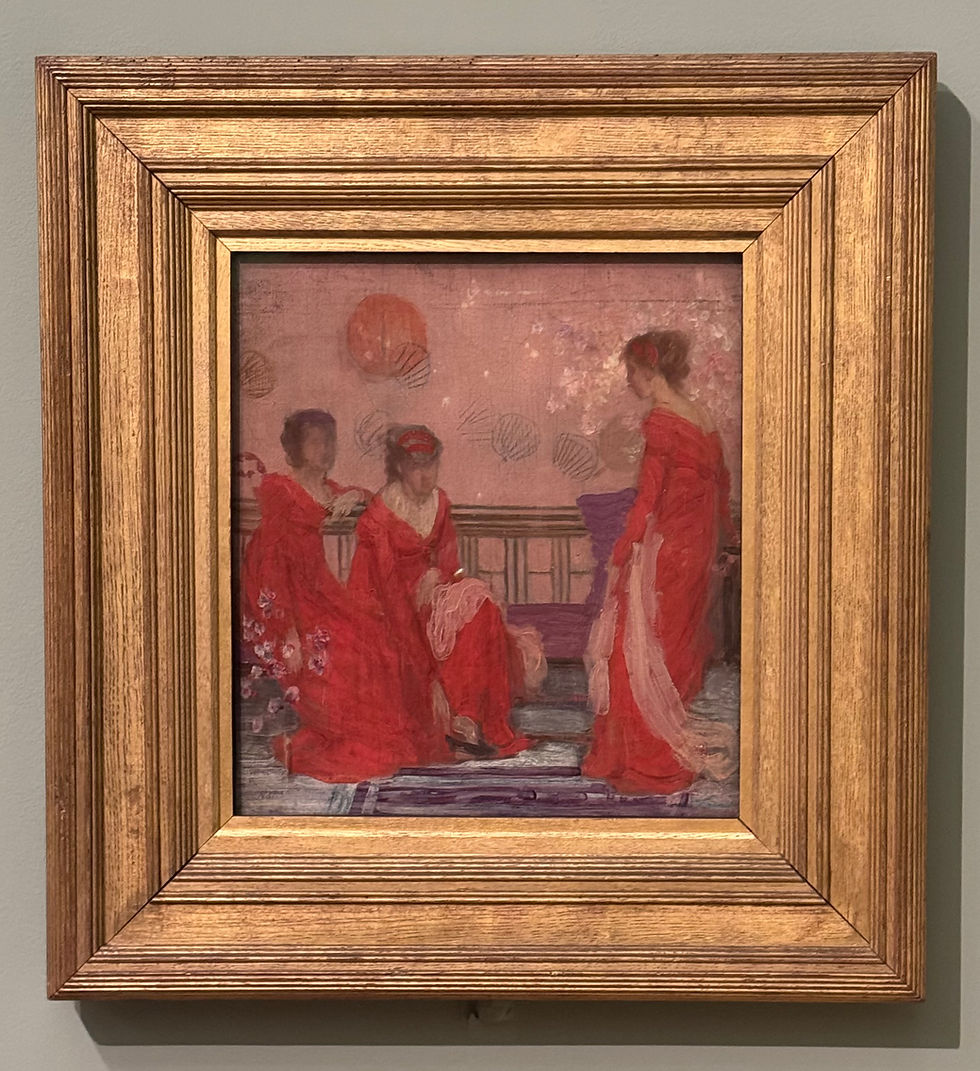
That is the kind of artistic influence that interests me most: the moment when something stops being visible only on the surface and begins to shape the artist from within.
Some of the most interesting art seems to emerge in that space. What begins as fascination can become study. What begins as study can become style. And what begins as style can, over time, become something far deeper.
Perhaps that is why I was still thinking about Whistler’s Japan after leaving the exhibition.
I was not simply looking at a nineteenth-century painter who liked Japanese things. I was looking at an artist who allowed another culture to change the way he saw. And in that, I recognised a question that continues to guide much of my own work.
How does an artist absorb an influence without merely copying it?
How does something foreign become personal?
And how does admiration become a language of one’s own?
____
Exhibition details
Further listening
Comments